One person, doing the work of a whole content team.
A podcast dies without short-form. Short-form needs a team.
One episode needs 30 clipped moments, 30 hooks, 30 captions, a posting calendar, and someone reading the numbers after. That's an editor, copywriter, strategist, and analyst. The Useful Podcast had one person.
So I built the team as an AI system.
A Claude Code skill runs the whole operation: transcript in, tiered reels cut with engineered hooks, schedule and captions generated, performance logged, tests closed. AI makes the editorial calls. Python cuts and tracks. I review and post.
4 of the first 11 Instagram posts broke out. On a channel with no audience.
760, 744, 596, and 563 views against a 500-view bar, week one. 60 reels shipped across two episodes, every cut frame-clean. And one discovery: the same clip can perform 50 times differently on Instagram versus YouTube.
EstimatedCompresses roughly 25 to 40 hours of team work per episode into 2 to 3 hours of review. Labeled an estimate: the manual version was never run.
Not a prompt. An operating system for a channel.
A versioned skill: one strategy doc, five playbooks, five Python scripts. Same process every episode, any guest. Seven phases, one loop.
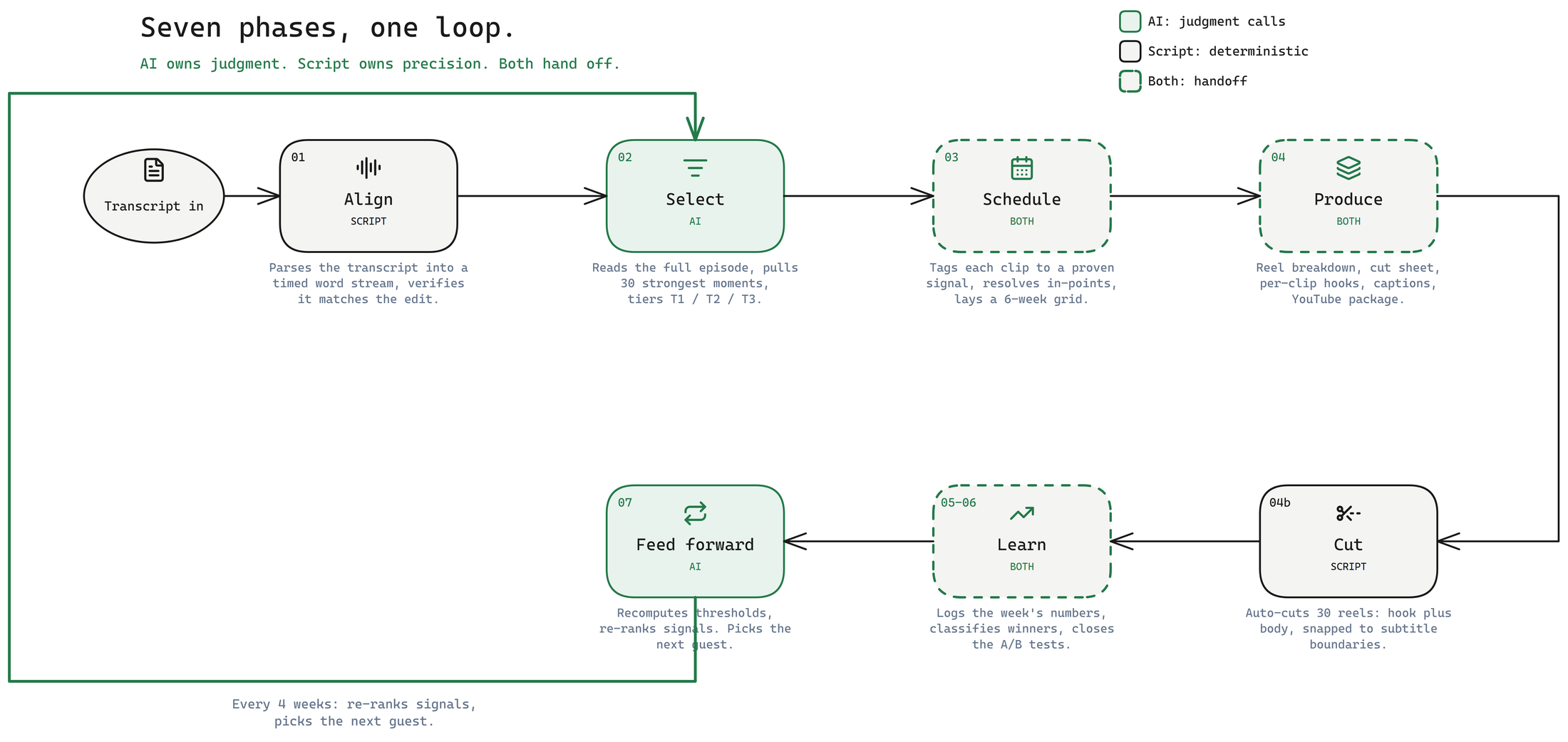
The AI does the taste. The code does the precision.
Neither is asked to do the other’s job. That split makes 30 reels a week trustworthy.
AI, where it has taste
Which moments carry an episode, which line to play cold, and what the numbers actually mean. The judgment a strategist would make.
Code, where it needs precision
Frame-exact cuts, formulas that never drift, thresholds that recompute on schedule. The deterministic work a human should never redo by hand.
A chatbot can write a caption. This is a system: taste and precision in their own lanes, every episode.
Never cut a word in half.
Up to half of viewers leave in the first 3 seconds. Early cuts used eyeballed timecodes and sliced words mid-syllable. The fix became the pipeline’s signature constraint.
A 2 to 5 second cold-open hook plus the body. Every cut snaps to a subtitle boundary, enforced by the build script, not by hope.
- 01Index
The episode's SRT captions are dumped as an indexed line list, one entry per phrase.
- 02Manifest
A JSON manifest defines each reel as subtitle indices: a hook line played cold, plus a body window for the payoff.
- 03Cut
One ffmpeg pass per reel seeks the two windows and joins them. 30 reels build in minutes from a 66-minute source, aspect ratio untouched.
- 04Iterate
Weak hook? Change one line of JSON, rebuild one file. Iteration costs seconds, not an editing session.
{
  "reel":      "dragon-pit",
  "hook_segs": [412],      // cold-open line
  "body":      [88, 96],   // payoff window
  "platform":  "instagram",
  "tier":      "T1"
}
Each reel is just subtitle indices. Change one line, rebuild one file.
Started as a one-episode prototype. Once it proved out clean, I promoted it into the skill as the permanent reel engine. Prototype, then productize, on purpose.
One clip, two platforms, 50 times apart.
The best Instagram clip of the launch got 744 views there and 12 on YouTube. Week one broke the assumption that a good clip is just good.
Instagram rewards share-bait: spicy, contrarian, system-rigged. YouTube rewards completion and search: vulnerable, identity. The pipeline now routes and judges each clip on its own platform’s threshold.
Every post is a data point. Every week closes a test.
The whole operation runs off a single tracker workbook with six sheets, updated by script so formulas never break.
Do “system is rigged” hooks beat wisdom hooks by 1.5x or more on Instagram sends and saves?
One variable. Three more tests queued behind it.- Win1.5x the rolling median within 48 to 72 hours.
- Double downWin 2 of 3, the signal earns more slots.
- KillLose 2 of 3, the signal drops off the priority list.
- RetestMixed result, change exactly one variable and run it again.
Self-raising bar: breakout thresholds recompute every 4 weeks as 1.5x the rolling median, so “good” gets harder as the channel grows.
The loop closes upstream too. The signal ranking shapes which questions the host asks next, and which guest gets booked.
30 reels are not equal. The schedule invests accordingly.
The calendar is a portfolio: proven signals get the best slots, base content keeps the cadence full, and the mix rebalances as inventory shifts.
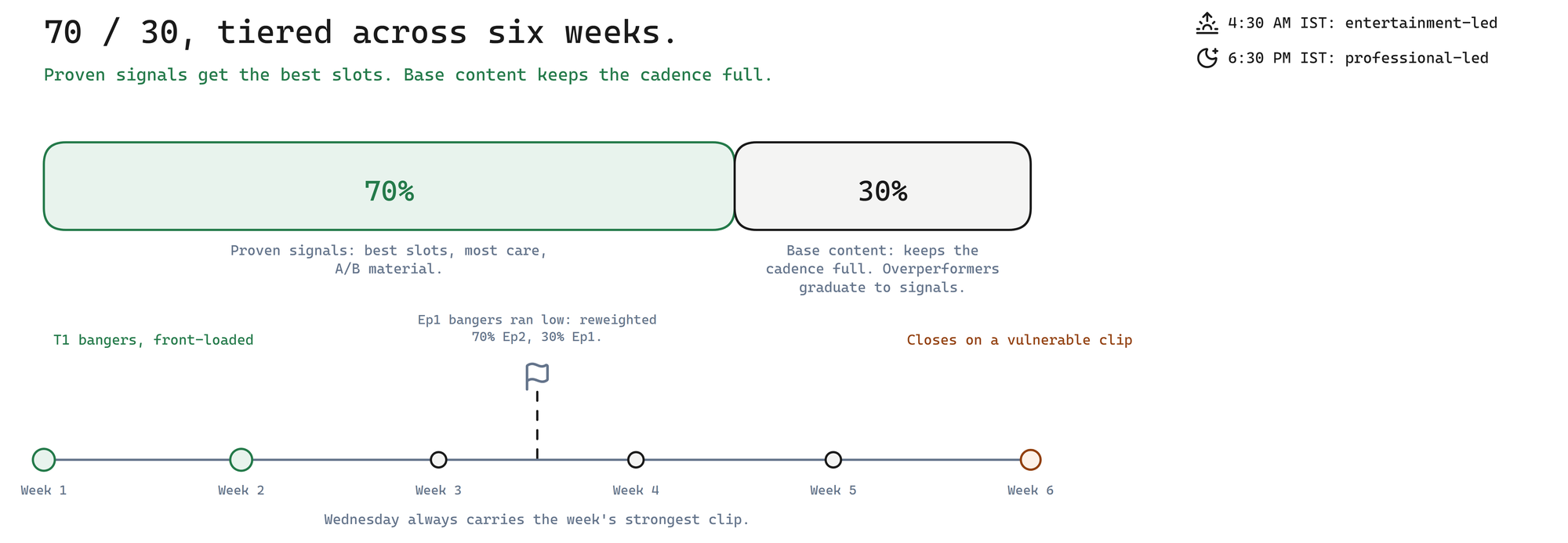
70 / 30 split
70% of slots go to clips matching proven signals, the best care and the A/B material. 30% keep the calendar full with base content. An overperforming base clip graduates into the signal list.
Tiering the calendar
Tier 1 bangers front-load weeks 1 and 2, so the algorithm learns on the best material first. Wednesday always gets the week's strongest. The season closes on a vulnerable clip, ending on warmth.
Two posts a day, two audiences
A 4:30 AM IST entertainment-led slot and a 6:30 PM IST professional-led slot, so one channel speaks to two rooms without diluting either.
Adaptive reallocation
When Episode 1's banger inventory ran dry, the system re-weighted to 70% Episode 2, 30% remaining Episode 1, leading with the unused spicy-tech clips the data favored.
Drop in a transcript and a video. Get back a channel.
- 30 reels, cut and tiered
Sorted into Banger, Daily Engine, and Filler folders, with an index CSV.
- A 6-week posting schedule
Per-clip signal tags, priority, platform, and test assignments.
- Engineered hooks
Frame-one on-screen text plus the exact spoken cold-open line, tuned per platform.
- 30 captions and a YouTube package
Hashtags, title, description, chapters, tags, and disclaimer cards where needed.
- A placement cut sheet
Timestamp-exact, so a human editor can match it frame for frame.
- An updated experiment tracker
The channel's memory and its strategy engine, in one workbook.
The impact, honestly.
One person runs a channel at team cadence, two posts a day, while the system gets measurably smarter every week. Here’s what is real and what is estimated.
- 60 publish-ready reels produced across 2 episodes, every cut frame-clean.
- 4 of the first 11 Instagram posts above the 500-view breakout bar: 760, 744, 596, 563.
- The same clip logged at 744 views on Instagram and 12 on YouTube, recorded, not guessed.
- A 7-phase pipeline installed as a reusable Claude Code skill: a strategy doc, 5 playbooks, 5 Python scripts.
- A live experiment tracker with test T-001 running and three more queued behind it.
- ~25 to 40 hours of team work per episode, compressed to ~2 to 3 hours of human review.Based on typical clipping-editor plus copywriter throughput. Labeled an estimate because the manual version was never run.
- ~$1,000 to $2,500 per month of content-team spend replaced, per episode cycle.Freelance rates of $10 to $30 per edited clip plus a part-time strategist, with tighter feedback loops than a team would give.
One month in, on YouTube.
Channel-wide numbers from YouTube Studio, not cherry-picked clips.
Episode 2's production kit flagged “no clean water in Canada” as a marquee Tier 1 banger before it posted. It became the channel's #2 most-watched short.
AI where it has taste
The system decides which moments, which hook line, and what the numbers mean. Judgment, not templating.
Code where it needs precision
Frame-exact cuts, spreadsheet formulas, and thresholds run in Python. Neither side is asked to do the other's job.
A loop that gets smarter
Every post is a data point, every week closes a test, and the ranking reshapes the next episode before it is even recorded.
Built for a podcast. The architecture fits any repeatable workflow.
AI judgment, deterministic scripts, a self-updating experiment loop. Fits any content or ops engine you need to run at team cadence, without a team.
Metrics on this page are from The Useful Podcast’s live channel analytics. Estimates are labeled as such throughout.